
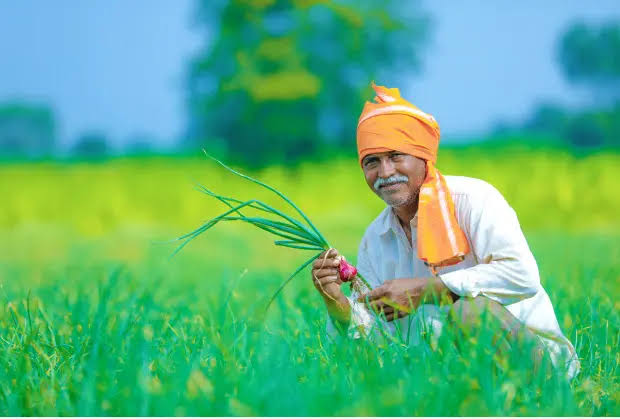
Definition of farmer Indian farmers are people who grow crops as a profession. Various government estimates (Census, Agricultural Census, National Sample Survey assessments, and Periodic Labour Force Surveys) give a different number of farmers in the country ranging from 37 million to 118 million as per the different definitions. Some definitions take in to account the number of holdings as compared to the number of farmers. Other definitions take into account possession of land, while others try to delink land ownership from the definition of a farmer. Other terms also used include 'cultivator'.
As per the 2014 FAO world agriculture statistics India is the world's largest producer of many fresh fruits like banana, mango, guava, papaya, lemon and vegetables like chickpea, okra and milk, major spices like chili pepper, ginger, fibrous crops such as jute, staples such as millets and castor oil seed. India is the second largest producer of wheat and rice, the world's major food staples. India is currently the world's second largest producer of several dry fruits, agriculture-based textile raw materials, roots and tuber crops, pulses, farmed fish, eggs, coconut, sugarcane and numerous vegetables. India is ranked under the world's five largest producers of over 80% of agricultural produce items, including many cash crops such as coffee and cotton, in 2010. India is one of the world's five largest producers of livestock and poultry meat, with one of the fastest growth rates, as of 2011[update]. One report from 2008 claimed that India's population is growing faster than its ability to produce rice and wheat.[20] While other recent studies claim that India can easily feed its growing population, plus produce wheat and rice for global exports, if it can reduce food staple spoilage/wastage, improve its infrastructure and raise its farm productivity like those achieved by other developing countries such as Brazil and China. India exported $39 billion worth of agricultural products in 2013, making it the seventh largest agricultural exporter worldwide, and the sixth largest net exporter. This represents explosive growth, as in 2004 net exports were about $5 billion. India is the fastest growing exporter of agricultural products over a 10-year period, its $39 billion of net export is more than double the combined exports of the European Union (EU-28). It has become one of the world's largest supplier of rice, cotton, sugar and wheat. India exported around 2 million metric tonnes of wheat and 2.1 million metric tonnes of rice in 2011 to Africa, Nepal, Bangladesh and other regions around the world. India has shown a steady average nationwide annual increase in the mass-produced per hectare for some agricultural items, over the last 60 years. These gains have come mainly from India's green revolution, improving road and power generation infrastructure, knowledge of gains and reforms.Despite these recent accomplishments, agriculture has the potential for major productivity and total output gains, because crop yields in India are still just 30% to 60% of the best sustainable crop yields achievable in the farms of developed and other developing countries. Additionally, post harvest losses due to poor infrastructure and unorganised retail, caused India to experience some of the highest food losses in the world.
Indian agriculture after independence Despite some stagnation during the later modern era the independent Republic of India was able to develop a comprehensive agricultural programme. In the years since its independence, India has made immense progress towards food security. Indian population has tripled, and food-grain production more than quadrupled. There has been a substantial increase in available food-grain per capita. Before the mid-1960s, India relied on imports and food aid to meet domestic requirements. However, two years of severe drought in 1965 and 1966 convinced India to reform its agricultural policy and that it could not rely on foreign aid and imports for food security. India adopted significant policy reforms focused on the goal of food grain self-sufficiency. This ushered in India's Green Revolution. It began with the decision to adopt superior yielding, disease resistant wheat varieties in combination with better farming knowledge to improve productivity. The state of Punjab led India's green revolution and earned the distinction of being the country's breadbasket.